Tempered glass lids combine a shaped glass panel with components such as a rim, handle, or other functional fittings. Producing them at factory scale therefore involves more than tempering glass alone. The production line must connect glass preparation, edge processing, cleaning, heat treatment, inspection, and assembly in a sequence that matches the finished lid design.
For cookware manufacturers, the useful question is not only how a tempered glass lid is made. It is also how each process should be arranged, what product information the line supplier needs, and how the equipment can be adapted to the factory’s space, output requirements, and product range. This article explains that production logic and shows where line integration becomes important.
What a Tempered Glass Lid Production Line Covers
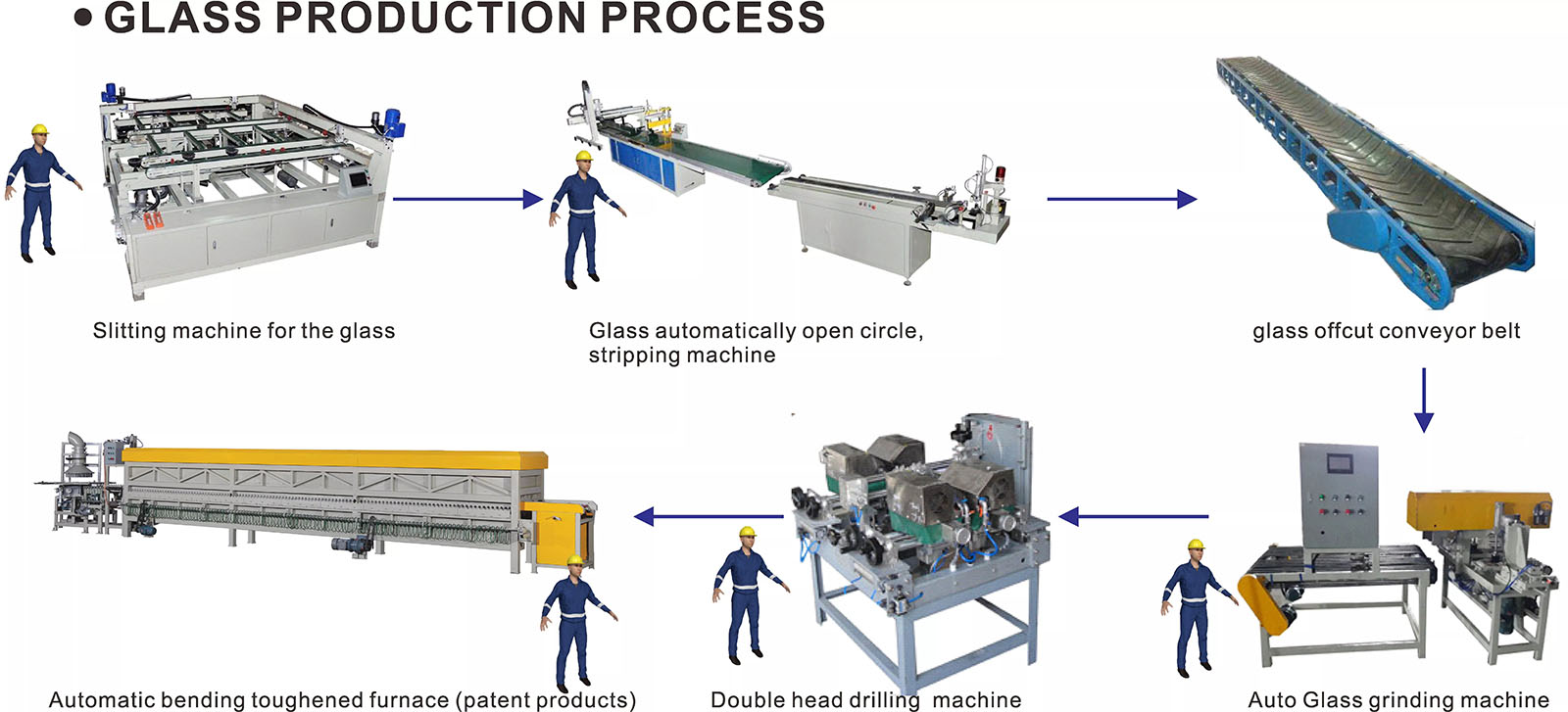
A tempered glass lid production line is a connected manufacturing system for turning prepared glass into finished cookware lids. The exact equipment list depends on the lid design, dimensions, edge treatment, ring material, handle structure, surface finish, and expected output. A standard line concept may include glass cutting or forming, edge finishing, drilling where required, washing, tempering, inspection, and component assembly.
Before equipment and layout are finalized, a manufacturer should define several practical inputs: investment budget, factory planning, product quality requirements, and daily production capacity requirements. These inputs shape the process route and help the line supplier develop a solution around the factory rather than around a fixed equipment package.
The Main Stages from Glass Preparation to Finished Lids
Although the exact sequence can change with the product design, the manufacturing route can be understood through six connected stages. The first stages prepare the glass. The middle stages develop the required surface and strength characteristics. The final stages bring the glass together with the other lid components and confirm that the finished product is ready for packing or the next production step.
Cutting, Shaping and Edge Processing
The process begins with glass prepared for the required lid size and shape. Round lids are common in cookware, but a production line may also need to handle rectangular or other special designs. Cutting and shaping must create a consistent outline before the edges are processed.
Edge processing is important because the edge becomes part of the finished lid assembly. It may need to work with a silicone ring, stainless-steel ring, or another component shown in the product design. The line layout should therefore consider the relationship between glass dimensions, edge treatment, and the component that will later be fitted around the lid.
At this stage, manufacturers should confirm the product range rather than planning around one sample only. A wider range of diameters, shapes, or edge requirements can affect equipment selection, changeover planning, and the amount of space needed around the line.
Drilling, Cleaning and Surface Preparation
Some lid designs require holes or openings for handles, vents, or other functional features. Where drilling is part of the approved process, the position and dimensions must match the component design. The line should also provide a controlled transition from machining to cleaning so that particles and residues do not move into later stages.
Cleaning and surface preparation support the next process steps. A clean surface is easier to inspect and provides a more consistent basis for printing, coating, or assembly when these features are included in the product specification. The appropriate sequence depends on the design and the supplier’s validated process, so the factory should confirm these details during solution design rather than assume one universal route.
Tempering and Quality Checks
Tempering is the heat-treatment stage that gives the glass its intended processed form. It should be treated as part of a connected production system, not as an isolated machine. The upstream stages must deliver glass in a condition suitable for tempering, while downstream handling must protect the processed glass and allow it to be inspected.
Quality checks may cover dimensions, edge condition, surface appearance, holes or openings, and the fit of the finished components. The exact inspection criteria should come from the manufacturer’s product requirements. It would be unsafe to assign specific temperature ranges, strength values, or defect limits without an approved technical specification.
The glass lid production line configuration presented by MOSTRO includes a reference output of 500 pieces per hour, a floor space of 1,000 square metres, and 15 to 18 workers. These figures describe that reference configuration and should not be treated as a universal capacity promise for every glass lid project.
Handle, Rim and Component Assembly
After the glass has passed through the required processing and inspection stages, it can be combined with the components that turn it into a usable cookware lid. Depending on the product, this may include a handle, a silicone ring, a stainless-steel ring, or another specified fitting. The assembly method should follow the approved product design and should be tested with the actual component set.
Assembly is also where the manufacturing process becomes closely connected to product variety. The glass lid configurations associated with this type of project may include C-type, G-type, and T-type lids, all-glass designs, big-hole and functional lids, PVD black and PVD gold finishes, rectangular lids, silicone rings, and stainless-steel rings. A factory should therefore plan the line around its intended product mix rather than a single finished-lid sample.
How the Production Stages Work Together
A production line is effective only when the individual operations work as one system. If cutting, edge processing, tempering, and assembly are planned separately, the factory may still face bottlenecks, unnecessary handling, or mismatched product flow. Line planning should connect process speed, equipment placement, inspection points, material movement, and the space required for finished products.
A complete line project normally includes needs analysis, process and layout design, review of the proposed solution, sample production, equipment testing, loading, installation, and follow-up support. Treating these activities as one project helps connect equipment selection with implementation requirements.
For a small or medium-sized factory, the main issue may be using floor space efficiently and keeping the workflow compact. For a larger plant, the priority may shift toward automated integration and a layout that can support higher-volume production. The correct design depends on the facility rather than on a standard line label alone.
What to Consider Before Planning a Glass Lid Production Line
|
Planning input |
Why it matters |
|
Product range |
Confirm lid shapes, dimensions, rings, handles, openings, and surface treatments. |
|
Daily output |
Define the expected production volume and whether it is based on one product or a mixed range. |
|
Factory conditions |
Review available floor space, material flow, utilities, storage, and operator movement. |
|
Quality requirements |
Set the inspection criteria for dimensions, edges, surfaces, assembly, and finished appearance. |
|
Growth plans |
Consider whether the layout should allow additional equipment, product variants, or later automation upgrades. |
When a Turnkey Production Line Is a Better Fit
A turnkey approach can be useful when a factory is building a new glass lid operation, combining several independent processes, or upgrading from isolated equipment to a coordinated line. The value is not simply that one supplier provides more machines. The important question is whether the supplier can connect the process design, layout, equipment list, testing, installation, and follow-up support around the factory’s actual requirements.
This approach is especially relevant when a manufacturer is developing a new factory, bringing several lid types into one operation, or moving from separate machines to a coordinated line. The final solution still needs to be confirmed against the product range, target output, available space, budget, and quality requirements.
Manufacturers planning a glass lid project can discuss a customized solution with MOSTRO. The relevant starting points are the Tempered Glass Lid Production Line and, where the project includes broader cookware production, the Cookware Production Line.
Contact Us
A useful production-line discussion should begin with practical project information: the lid types and sizes to be produced, the required daily output, the available factory area, the desired level of automation, the quality requirements, and any plans for future expansion. With these details, the manufacturer and line supplier can discuss the process as a connected layout rather than as a list of unrelated machines.
Manufacturers can contact MOSTRO to discuss a glass lid production line based on their product range, factory conditions, and output requirements.