
Material Structure and Forming Implications
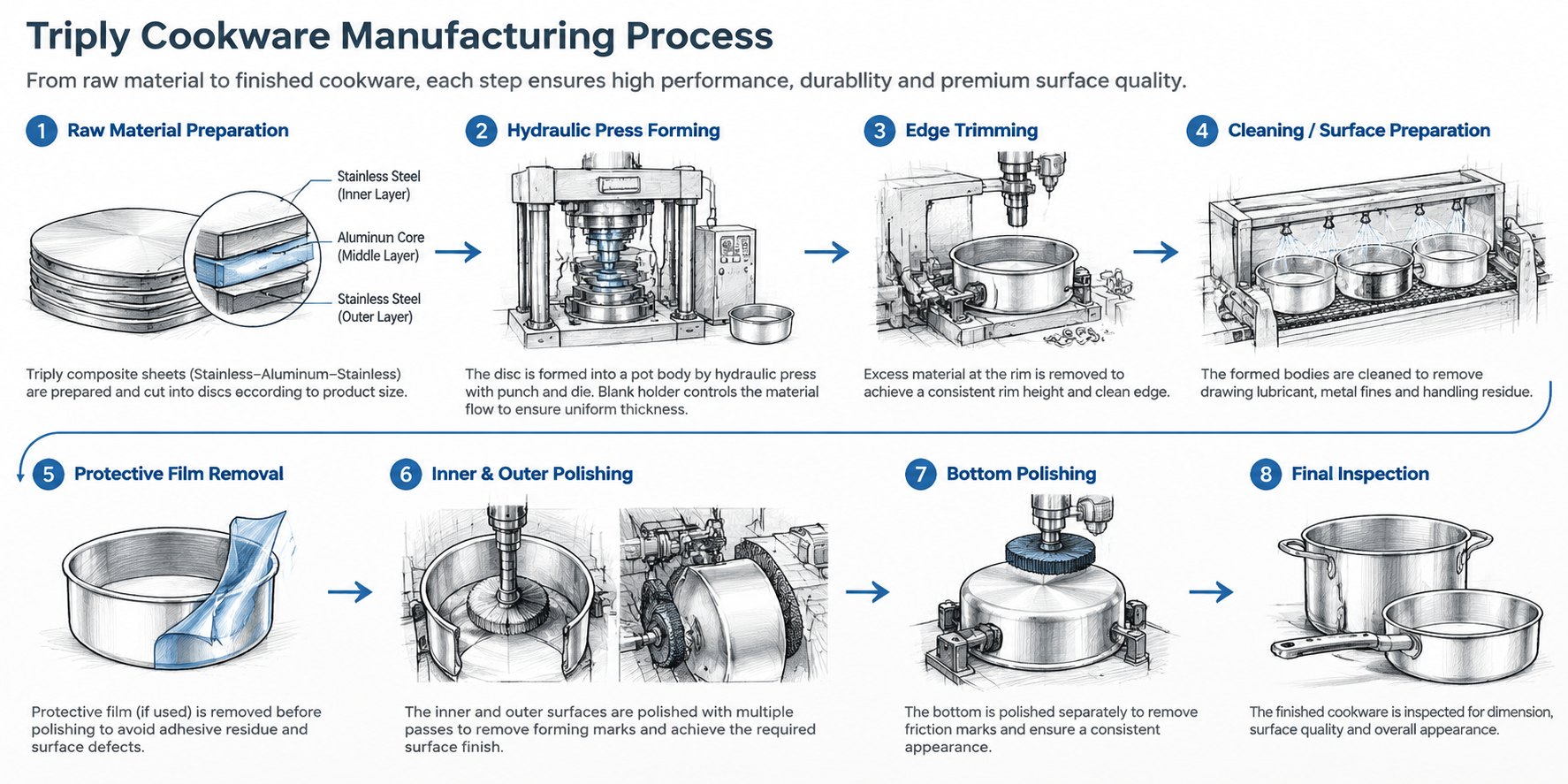
A triply cookware body starts as a bonded disc, not a single sheet. The stack pairs a stainless steel cooking surface with a stainless exterior and an aluminum core between them. Stainless grades such as SS201, SS304 and SS430 appear in this product family, and the aluminum core provides the conductive layer. The exact grade combination and layer thickness vary by product; the material structure should be read from the specification rather than assumed from a single sample.
The aluminum core exists for heat spreading. Aluminum conducts heat far better than stainless steel, so the core moves burner energy laterally across the base before it reaches the cooking surface. The stainless layers provide the food-contact interface and the structural stiffness. SS304 is a common food-contact choice for its corrosion resistance and formability. SS430 is ferritic and magnetic, which suits induction bases, but it offers less corrosion resistance than 304 in prolonged wet exposure. SS201 sits below 304 on corrosion resistance and is generally used in cost-sensitive applications.
For forming, the practical consequence is that the blank does not behave like homogeneous stainless sheet. The aluminum core is softer and flows differently under the punch, while the stainless skins carry much of the tensile load. A triply cookware manufacturing process has to account for that layered response from the first draw onward.
Hydraulic Press Forming for Triply Bodies
Hydraulic presses form the triply disc into a pot body using a punch and die set. The punch pushes the center of the blank into the die cavity while a blank holder controls how the outer flange feeds inward. On multi-ply blanks, that control matters more than on single-layer stainless: if the blank holder releases too much material at once, the aluminum core can flow unevenly relative to the steel skins, and the wall thickness distribution becomes harder to predict.
Different pot sizes are matched to different press specifications. A small pot may complete in a single draw under the right conditions, while deeper or larger bodies can require more than one forming stage. The draw ratio—blank diameter relative to punch diameter—and the material's forming limits determine whether one stroke is feasible. A press with more force cannot compensate for a draw that exceeds what the material can flow through in a single operation.
Hydraulic presses in cookware lines are often paired with robotic handling. The manipulator transfers the blank or formed body between stations, which reduces the dependence on manual loading and keeps the cycle consistent. The press provides the force and stroke; the handling system determines how predictably that force is applied from part to part.
Forming issues on triply bodies include wrinkling at the flange when restraint is insufficient, tearing near the punch radius when the material cannot feed, and localized thinning where the stainless skins are drawn over a tight radius. The aluminum core does not eliminate these risks; it adds a layer whose deformation has to stay compatible with the steel on both sides.
Edge Trimming and Mold Selection
After forming, the pot body carries excess material at the rim. Edge trimming removes that allowance and establishes a consistent rim height. The trimming tool is matched to the pot diameter and profile, and a dull or misaligned trim die leaves a ragged edge that carries into later handling. The trimmed rim also sets the reference for how the body sits in subsequent fixtures, so trimming variation propagates into polishing and inspection.
Mold selection extends beyond the forming die. Triply bodies can be produced with different surface patterns, including a hammered design. Different molds and tooling steps correspond to different product appearances, and the resulting surface condition changes what polishing has to do. A hammered exterior cannot be polished the same way as a smooth brushed wall; the recessed areas of the pattern need different contact pressure and access from the polishing tool. Product appearance requirements therefore reach back into mold selection, not just the final finishing room.
Cleaning and Surface Preparation
Between trimming and polishing, the body is cleaned to remove drawing lubricant, metal fines and handling residue. Residual lubricant on the surface interferes with polishing compound contact and can cause uneven cut or burnishing marks. The cleaning step also removes particles that might otherwise be pressed into the surface during polishing and leave scratches that require additional passes to remove.
Some bodies carry a protective film during processing. The film shields the surface from handling marks, but it has to come off before polishing. Adhesive residue left behind after film removal can smear or uneven the polishing result, particularly on the interior surface where access is limited. Film removal is not universal across every triply product, but when it is used, the timing relative to cleaning and polishing affects the surface outcome.
Inner, Outer and Bottom Polishing
Polishing on a triply body is divided by surface, and each surface has different requirements.
The interior surface is the food-contact face. It is typically polished to a smoother, more uniform finish than the exterior. Coarse polishing removes the drawing marks and levels the surface; finer passes reduce the scratch depth and bring the finish to the specified roughness. The tool path has to follow the pot's interior curvature without applying uneven pressure at the bottom radius, where the wall meets the base. Excessive pressure in that transition zone can leave a visible band that is difficult to blend out.
The exterior receives its own sequence. If the body has a hammered pattern, the polishing tool has to work around the pattern rather than cutting it down. Smooth exteriors are polished for appearance and to remove handling scuffs. The outer surface is where the surface finish requirement is most visible, and the condition left by trimming and cleaning shows up here first.
Bottom polishing is treated as a separate operation for a practical reason. The base of the pot contacts conveyors, fixtures and adjacent parts as it moves through the line. Even careful handling leaves friction marks and light scratches on the bottom surface. Those marks are not always visible from the cooking position, but they affect the product's appearance when the pan is turned over or displayed. A dedicated bottom polishing step addresses the base after the main body polishing is complete, and the result is checked visually for remaining scratches and consistency with the rest of the exterior finish.
Quality Control Points Along the Line
Quality checks on a triply line follow the sequence of operations rather than concentrating at final inspection.
At material receipt, the layer thickness and surface condition of the bonded disc matter because a core that is under-thickness or a stainless skin with handling damage will show up as forming defects later. After hydraulic forming, the body is checked for shape, wall integrity and rim levelness. Wrinkles that were pressed flat during forming can remain as surface discontinuities that polishing cannot fully remove.
After trimming, the rim edge is examined for burrs and height consistency. A rim that varies in height around the circumference will sit unevenly in polishing fixtures and may be polished more heavily on one side. After cleaning, the surface is checked for residual film adhesive or lubricant streaks before the body enters polishing; polishing over contamination wastes passes and can embed particles.
The final check focuses on the polished bottom and the overall surface state. Scratches that remain after polishing are assessed for depth and location. A scratch on the interior cooking surface has different acceptance implications than a light mark on the bottom that will be hidden in normal use. Inspection on the line is primarily visual; laboratory testing methods sit outside routine production checks.
Production Line Coordination and MOSTRO Reference
The triply cookware production line works as a chain in which each station's output becomes the next station's input condition. Hydraulic forming sets the wall thickness distribution and the surface marks that trimming and polishing must address. Trimming establishes the rim datum that fixtures rely on. Cleaning determines whether polishing can cut evenly. Inner, outer and bottom polishing are sequenced so that the surfaces that need the most protection are handled after the coarser operations.
Pot size changes ripple through the whole chain. A different diameter means a different blank, a different forming die, a different trimming tool and a different polishing fixture. The press may have the tonnage for the new size, but if the handling system and polishing stations are not set for it, the line does not actually run that size efficiently.
MOSTRO's Triply Cookware Production Line page covers the forming and handling configuration around this process. For lines being planned around specific pot sizes and surface finishes, the equipment specification should start from the material stack and the polishing requirements rather than from press tonnage alone.