Chef Knife Manufacturing Solution
Build an Efficient Production Line for Consistent Chef Knife Quality
From stainless steel sheet to the finished chef knife, we help manufacturers establish a stable and efficient production system with better control of blade hardness, straightness, edge geometry, surface finish, and overall product consistency.
Whether you are setting up a new knife factory, expanding production capacity, or upgrading an existing workshop, MOSTRO develops the production line according to your knife design, steel grade, handle structure, quality level, target capacity, available factory space, and investment budget.
Industry Challenges
Common Challenges in Chef Knife Manufacturing
- High Dependence on Skilled Workers:
Traditional grinding, polishing, and sharpening operations rely heavily on experienced workers. Differences in operator skill can directly affect blade shape, surface finish, and cutting performance. - Unstable Heat Treatment and Blade Hardness:
Improper quenching and tempering parameters may cause inconsistent hardness, insufficient edge retention, excessive brittleness, or deformation of the blade. - Blade Deformation During Production:
Thin knife blades can bend or twist during heat treatment, grinding, and polishing, creating additional straightening work and increasing rejection rates. - Inconsistent Grinding and Edge Geometry:
Uneven blade thickness, bevel angles, grinding depth, or sharpening angles can result in inconsistent cutting performance between knives. - Surface Finish Quality Is Difficult to Control:
Grinding marks, polishing defects, scratches, uneven satin finishes, and poor transition areas can affect the appearance and positioning of premium kitchen knives. - Production Bottlenecks Between Processes:
If blanking, heat treatment, grinding, polishing, handle assembly, and sharpening capacities are not properly balanced, work-in-process inventory increases and overall production efficiency decreases.
Our Solution
Complete Chef Knife Manufacturing Support
- Product-Based Process Planning:
We design the production process according to blade dimensions, steel grade, thickness, required hardness, blade geometry, surface finish, handle construction, and production capacity. - Integrated Equipment Selection:
MOSTRO coordinates the machinery required for blanking, blade forming, heat treatment, straightening, grinding, polishing, handle production, sharpening, cleaning, and inspection. - Heat Treatment Process Control:
Suitable quenching and tempering systems are selected according to the knife material and required hardness to help achieve stable blade performance and reduce deformation. - Grinding & Polishing Optimization:
The grinding process can be configured for rough grinding, bevel grinding, fine grinding, surface polishing, and edge preparation to achieve consistent blade geometry and appearance. - Flexible Handle Manufacturing:
Production solutions can be developed for different handle constructions, including injection-molded plastic handles, ABS/TPR handles, riveted handles, wooden handles, and stainless steel handle structures. - Practical Automation:
Semi-automatic and automatic equipment can be introduced for feeding, grinding, polishing, sharpening, handling, and other repetitive processes to reduce labor dependence and improve consistency. - Installation & Technical Support:
MOSTRO provides equipment testing, production trials, commissioning guidance, operator training, and technical support to help customers establish a stable production system.
Recommended Production Process
Typical Workflow for Stainless Steel Chef Knife Manufacturing
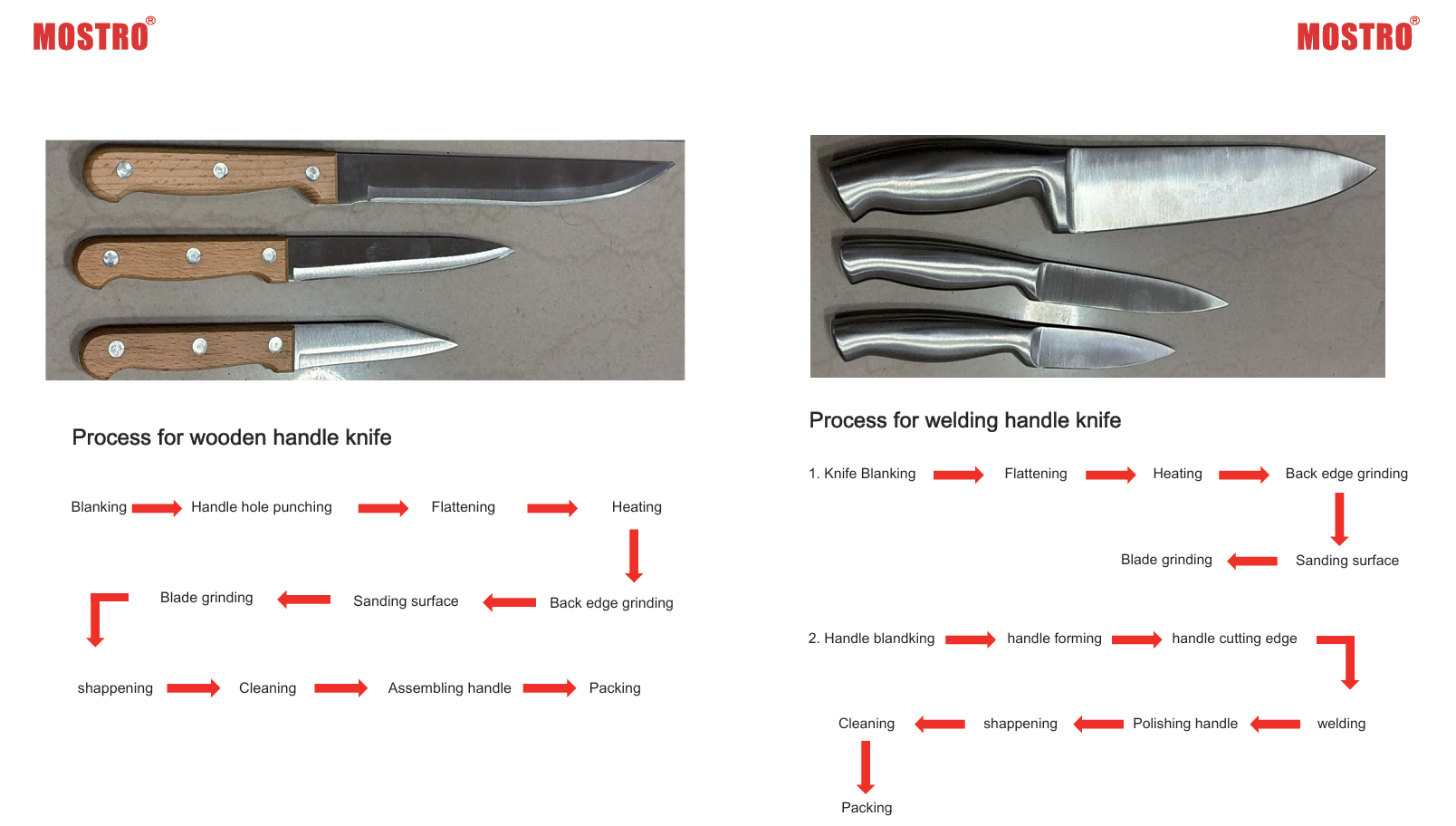
Raw Material Preparation → Blanking → Blade Forming / Shaping → Heat Treatment → Straightening → Rough Grinding → Blade Bevel Grinding → Fine Grinding → Surface Polishing → Handle Assembly → Edge Sharpening → Cleaning → Inspection → Logo Marking → Packaging
Production begins with stainless steel sheet selected according to the required knife grade, thickness, hardness, and product positioning.
The blade profile is first produced through blanking and forming operations. The knife then enters the heat treatment stage, where controlled quenching and tempering establish the required blade hardness and mechanical properties.
After heat treatment, blade straightness is checked and corrected where necessary.
The blade then passes through several grinding stages. Rough grinding removes excess material, while precision bevel grinding creates the required blade geometry and cutting profile. Fine grinding and polishing further improve surface quality and prepare the blade for final finishing.
Depending on the product design, the handle can be manufactured and assembled using plastic injection molding, internal handle inserts, rivets, wooden scales, stainless steel components, or other customized structures.
Final edge sharpening creates the required cutting angle and sharpness. The finished knife is then cleaned, inspected, marked with the required brand or logo, and packed.
The exact production sequence can be adjusted according to the knife design, steel material, blade thickness, handle structure, surface finish, automation level, and target production capacity.
Manufacturing Strength
A Production Partner from Planning to Start-Up
- Kitchenware Manufacturing Experience: Process knowledge that connects product requirements with equipment selection.
- Project Coordination: Support across machinery supply, production layout, testing, and installation.
- Customized Line Design: Equipment configurations developed for your factory conditions and production goals.
- Sample-Based Verification: Trial production and equipment testing help assess forming results and product quality before delivery.
- International Technical Support: Installation assistance, operator training, and follow-up support for overseas customers.
Production Lines
Cutlery Production Line
Explore MOSTRO’s cutlery production solutions for blanking, forming, polishing, cleaning, and finishing. Equipment and automation options can be configured for your product mix and planned production scale.
Share your product samples or drawings, target output, and factory layout with our team to discuss a suitable manufacturing solution.