Buying a press first is backwards. What actually dictates the line is blank deformation. A 2-inch skillet and an 8-quart stockpot might start as identical circular blanks, but they demand entirely different tooling, tonnage profiles, and transfer setups. Figure out the metal deformation upfront, or you end up with an expensive bottleneck.
Blank Behavior Under the Ram
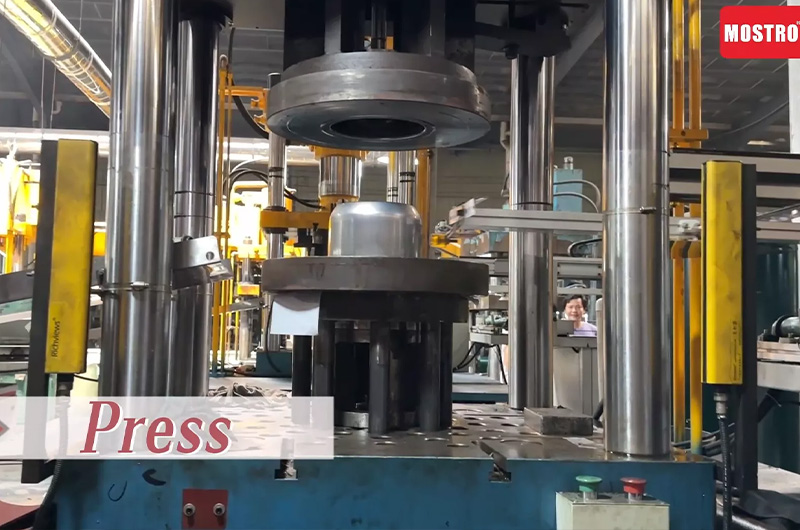
Deep drawing pulls material inward from the flange. It does not stretch-form it across the cavity, at least not intentionally. The blank holder grips the perimeter to meter metal flow while the punch draws the sidewall down. If that wall thins past its limit, the bottom tears out. Most cookware geometries blur this line slightly, especially across radiused corners where stretching creeps in.
This breakdown focuses exclusively on sheet forming. For cast or forged aluminum, read MOSTRO’s overview on alternative cookware manufacturing processes.
Material properties dictate tooling wear.Material properties affect both forming loads and tooling requirements. Stainless steel can present challenges with galling and work hardening, so tool finish, lubrication and wear resistance need to be considered during die design. Aluminum generally requires a different forming setup, while its directional properties can affect the uniformity of the drawn rim. Clad sheet should be tested in its actual production condition before the die design is finalized. Aluminum is more forgiving on tonnage, but earing is a constant headache. For aluminum cookware, alloy, temper and sheet quality should be specified for the intended forming operation. Earing should also be assessed during material qualification and forming trials. Clad materials—stainless over aluminum core—behave like neither metal on its own. Run press trials with the exact production clad before committing to a die set.
Single vs. Multi-Stage Draws
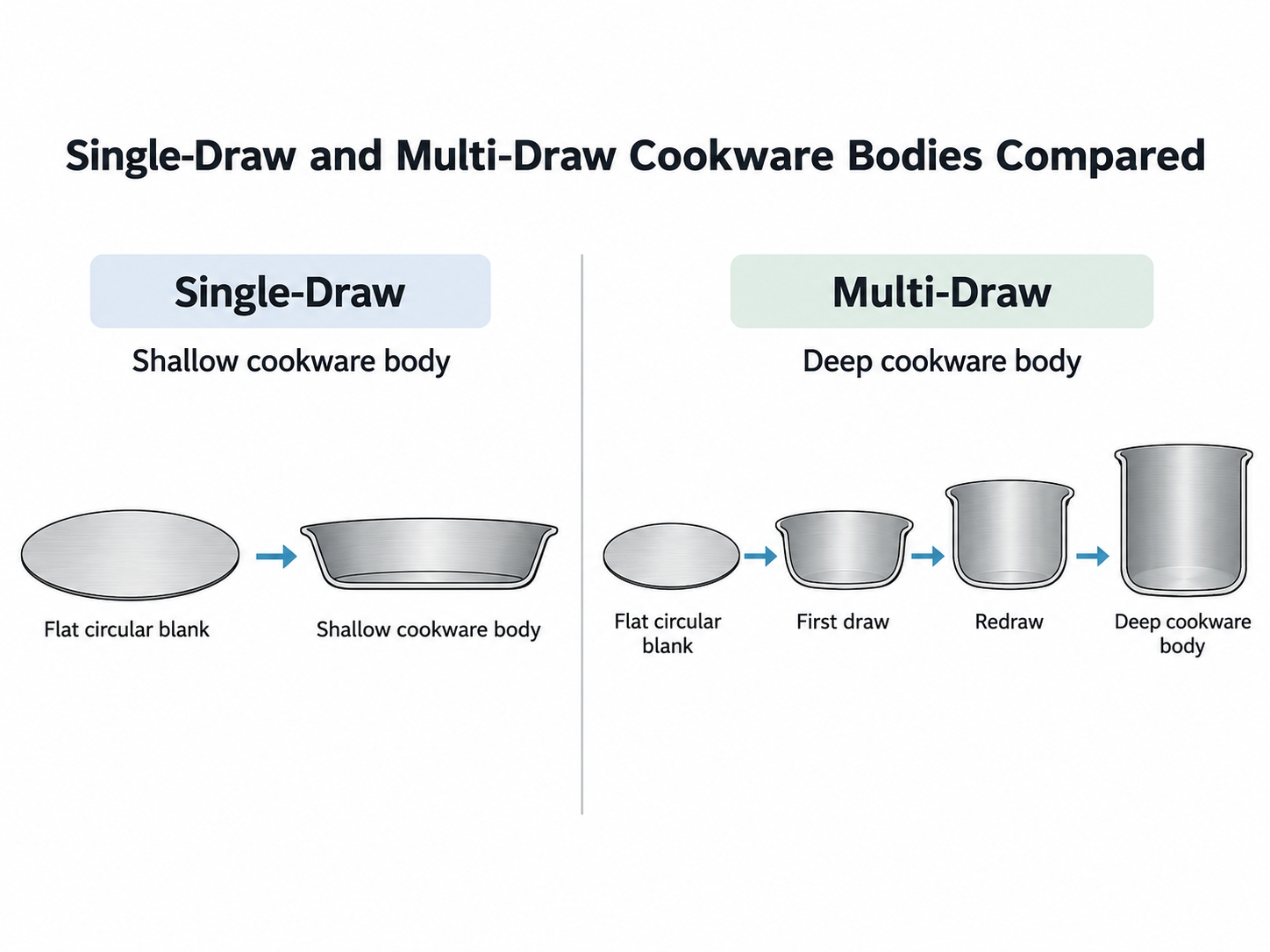
The draw route hangs on the Limiting Drawing Ratio (LDR). Push past the material’s single-stroke reduction limit and the blank fractures. Deep pots need two, three, or four passes, with each subsequent station taking a smaller reduction.
Work hardening sets in after stroke one. Does that mean in-line annealing? Not always. Plenty of stainless runs skip annealing entirely through smart die design and proper lubrication. But if your depth-to-diameter ratio forces a furnace run, remember the fallout: If intermediate annealing is required, it adds another stage to the production route. Cleaning, heat treatment and preparation for the next draw should be specified according to the material and process requirements. That turns a simple three-press cell into a messy, multi-stage wash-and-heat loop.
Dialing in the blank holder is a constant tightrope. Too little clamp and the flange wrinkles instantly. Too much clamp and the bottom tears out. As the draw gets deeper, that margin of error disappears. Tonnage numbers and draw radii belong on part drawings, not in broad guides.
Line Layout and Auxiliary Machinery
Blanking dictates your material yield. You either run automated decoiling, leveling, and circle-blanking in-house, or pay a premium for pre-cut circles. That choice alone reshapes your raw material storage and scrap handling.
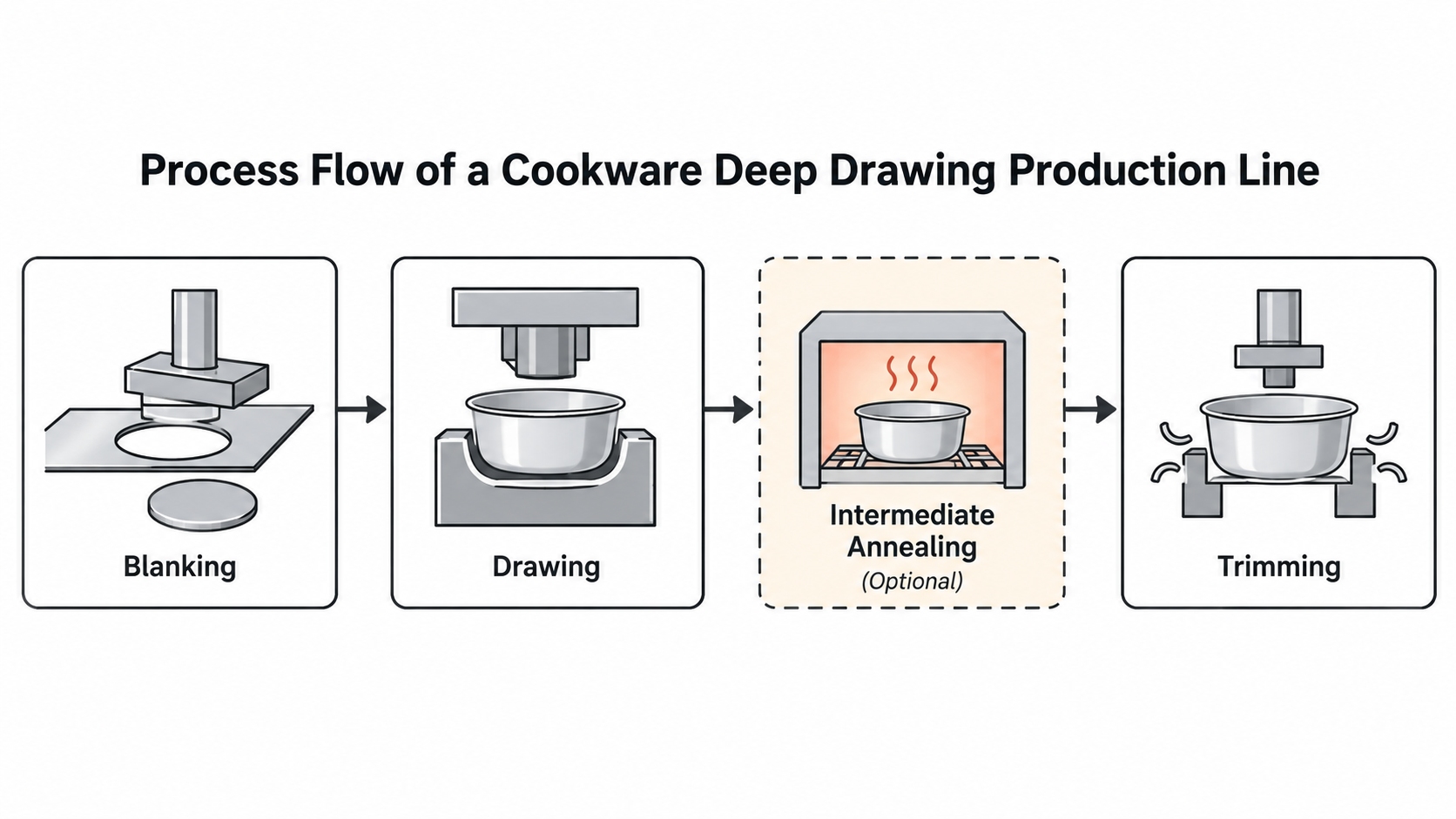
On the press side, stroke length, bed clearance, and precise cushion control matter far more than whether the drive is hydraulic or mechanical. Multiple draws can be arranged in a transfer press or across separate presses linked by part-handling equipment. The suitable arrangement depends on the product, required operations, production volume and changeover frequency. The right call depends on batch sizes and changeover frequency.
Drawn shells come off the press with wavy, uneven flanges caused by anisotropic earing. That excess metal has to go. Edge trimming can run as an integrated secondary station or on an off-line rotary trimmer. Downstream operations—curling, edge rolling, bead forming, and surface finishing—are detailed in how stainless steel cookware is made in five steps. Two things matter at the transfer point: shell orientation off the die, and whether edge trimming can match the press cycle time without starving the line.
What to Hand Your Equipment Builder
A machinery builder cannot size a line without hard part geometry. Bring finished part prints with depth, finished trim diameter, wall thinning allowances, and base radii. Bring raw material specifications: exact alloy, temper, sheet thickness, and cladding ratios.
Most importantly, ship real sheet samples for die trials. MOSTRO’s cookware project engineering covers trial runs and pre-shipment tool validation, which saves weeks during commissioning. Once parts and cycle rates are dialed in, check MOSTRO’s custom cookware production lines to evaluate turnkey line layouts.