A pot is designed so heat spreads evenly through a consistent wall section, usually with a heavier base. A spoon is designed the other way round—thick metal at the neck and handle so it does not bend in the hand, tapering to a thin bowl or slender tines. When you add table knives into the mix, blade hardening and wet grinding enter the picture too.
For importers and regional kitchenware brands moving from sourcing finished flatware to running a stainless steel cutlery production line, getting those process splits right before ordering machines saves months of commissioning headaches.
Factory Floor Space, Output, and Staffing Benchmarks
Most buyers start by asking for machine prices, but civil prep and staffing come first. Line cost is driven mainly by polishing head count, whether the knife cell is included, and the level of automation. Based on MOSTRO's standard mid-volume turnkey setups, a core spoon and fork line sits around these baseline numbers:
| Key Planning Metric | Standard Line Benchmark | Operational Notes for Buyers |
|---|---|---|
| Production Line Output | 800 – 1,000 pcs/hour | Varies by flatware weight, stainless grade, and polishing pass count |
| Required Floor Space | ~1,000 m² | Covers coil storage, press shop, partitioned polishing room, wet cleaning/passivation, and packing |
| Operating Workforce | ~15 workers | Covers coil feeding, press tending, polishing fixture loading, QC, and packing |
| Primary Flatware Scope | Spoons & Forks (core) / Table Knives (optional cell) | Adding table knives adds dedicated finishing stations, floor area, connected power, and staff |
Picking Steel Grades for Spoons, Forks, and Knives
Cold-rolled stainless coil is the starting point, and the grade you pick locks in press loads, polishing fixtures, and heat-treatment requirements. Spoons and forks usually run on austenitic SS304 for food-contact corrosion resistance and smooth cold forming, or ferritic SS430 where lower material cost and magnetic properties matter. Entry-level lines sometimes use SS201, though it work-hardens fast on blanking dies and carries a real risk of pitting corrosion in humid climates or commercial dishwashers.
Table knives cannot use 304 for the blade because austenitic grades will not harden under heat treatment. One-piece table knives require martensitic SS420, which goes through quenching, tempering, and wet blade grinding—much like the blade-hardening steps covered in the knifemaking process of chef knives. Higher-end sets use a two-piece build instead, joining a hardened SS420 blade at the tang onto a stamped hollow handle.
Blanking, Cross-Rolling, and Hydraulic Forming
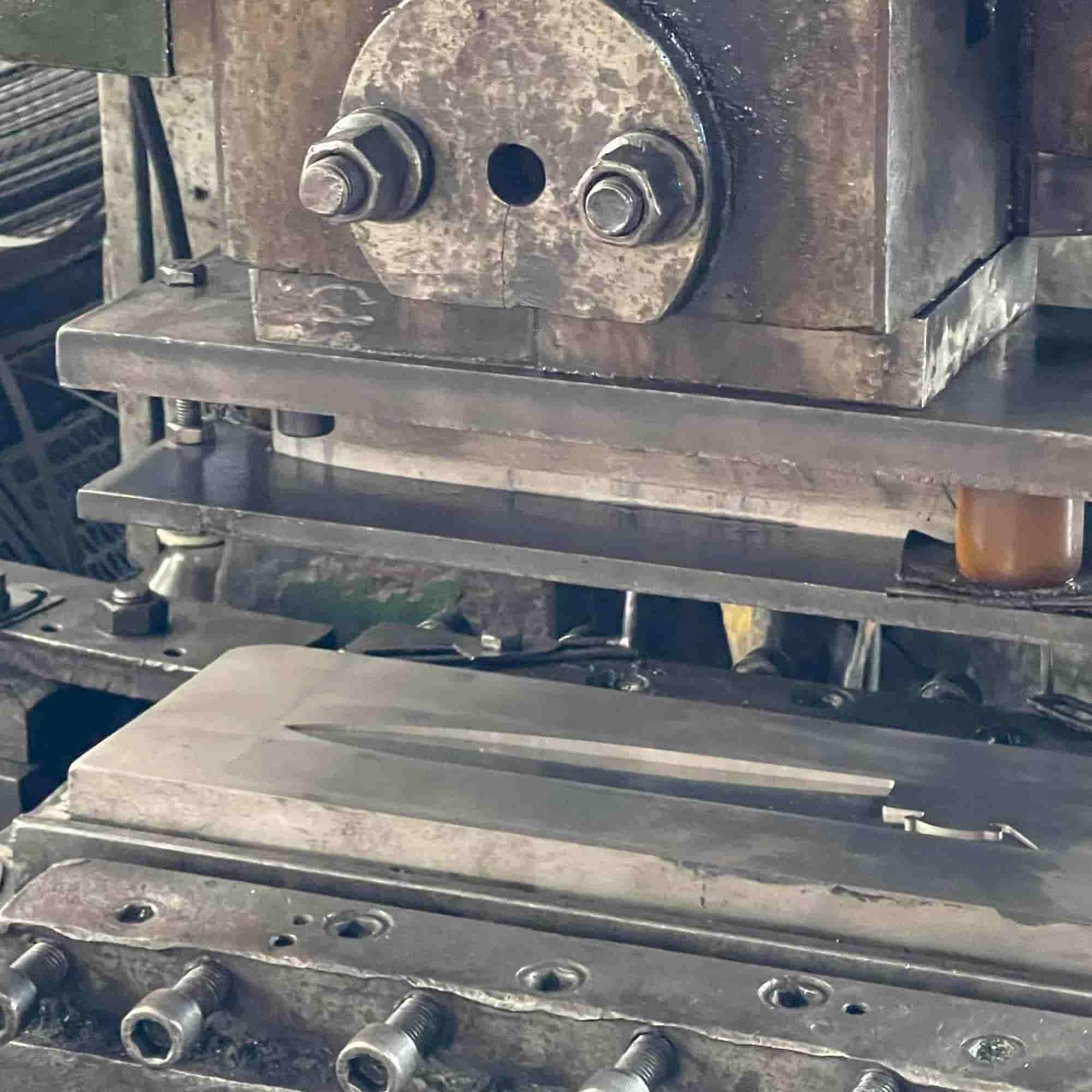
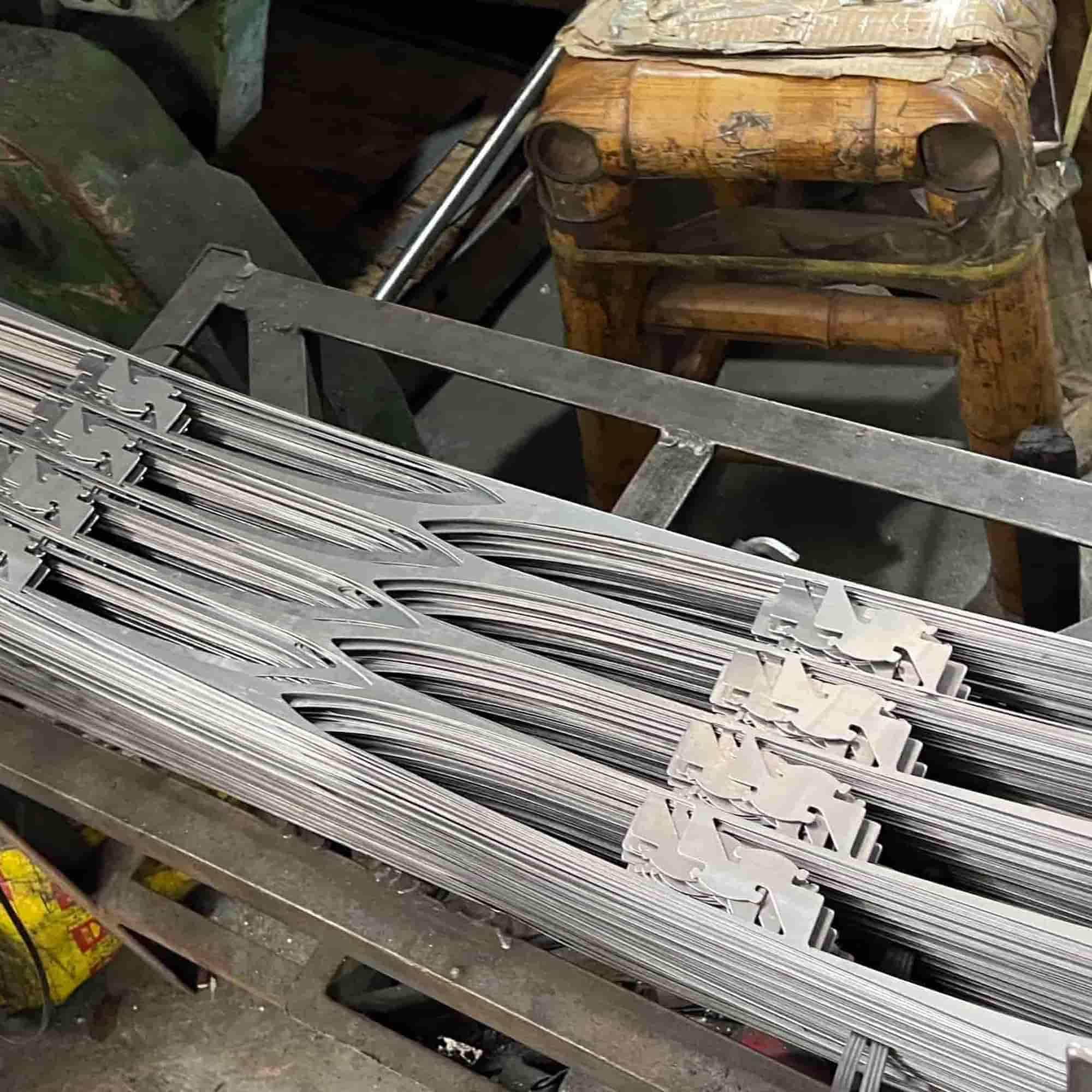
Production starts at an uncoiler and straightener that flattens coil set before feeding strip into a high-speed blanking press. Tightly nested dies punch out flat paddles while keeping skeletal scrap low. Keep the blanking blades sharp: any heavy burr left around the perimeter gets rolled straight into the metal surface at the next station, turning into embedded defects that polishing wheels cannot buff out.
Flat spoon and fork blanks then go through precision cross-rolling mills. Hardened rollers compress the front end longitudinally and transversely, thinning and widening the metal into a rough bowl or fork head while leaving the handle at full gauge. Heavy designs usually split this reduction across two passes so the edges do not crack.
Table knives skip the cross-rolling mill altogether. Their blade taper comes from wet grinding later on, not from transverse rolling.
After rolling, trimming presses punch out the exact outer profile. Fork tines are the picky part here—if punch-to-die clearance drifts too wide, rolled-over burrs form inside the narrow tine gaps and cause constant rework on the polishing line. Trimmed spoons and forks then move to coining dies for handle patterns and a hydraulic forming press to curve the spoon bowl and arch the handle.
Polishing Lines, Jigs, and the Wet Passivation Tank Line
Finishing eats up the biggest share of labor and consumables in a flatware plant. Blanks coming off the presses carry rolling lines, die marks, and stamping oil, so rotary or linear polishing lines step them progressively from coarse sisal or flap wheels down to cotton buffs loaded with solid polishing wax.
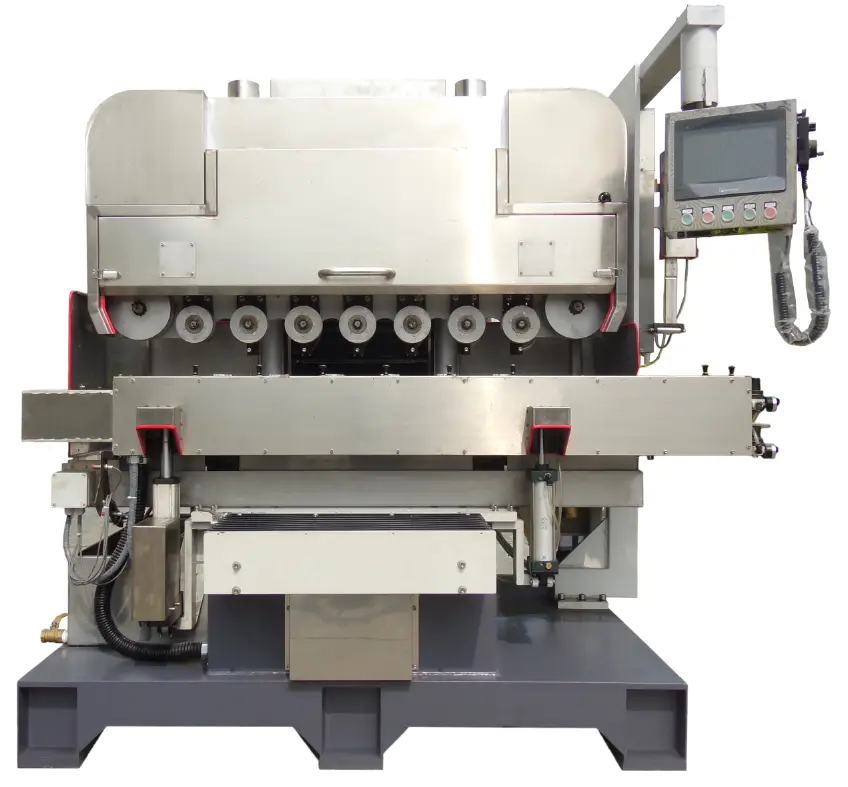
On most lines we commission, the bottleneck is rarely the stamping press—it is the polishing fixture setup. Magnetic chucks work fast and hold tight on ferritic SS430 spoons and forks as well as martensitic SS420 knives. Non-magnetic SS304 has to run on mechanical clamping jigs or contoured carriers so parts do not slip or get their handle edges rounded off under buffing pressure. Knife handles can share this polishing line with dedicated fixtures, but blade faces must be ground and finished on separate stations so buffing wheels do not dull the edge or flatten steak-knife serrations.
Once polishing and grinding are done, flatware goes through a multi-tank wet line—ultrasonic degreasing, rinsing, chemical passivation, deionized (DI) water rinsing, and hot-air drying—to strip compound out of embossed patterns and rebuild the passive surface film. If you are launching your first plant, we generally advise holding off on PVD color coating chambers until the base polishing and passivation line hits steady daily yield.
Shared vs. Dedicated Stations Across the Line
If you want to produce full sets under one roof, spoons, forks, and table knives share the front-end coil handling and back-end cleaning/packing sections, while splitting in the middle:
| Production Station | Spoons & Forks | Table Knives | Engineering & Configuration Notes |
|---|---|---|---|
| Uncoiling & Straightening | Shared | Shared | Removes coil set for consistent press feeding |
| Blanking & Edge Trimming | Shared | Shared | Dedicated die sets required per SKU and size |
| Cross-Rolling Mill | Dedicated | Not Used | Thins and widens spoon bowls and fork heads only |
| Embossing & Bowl Forming | Dedicated | Embossing Only | Knives skip bowl curving |
| Heat Treatment (Quench/Temper) | Not Used | Dedicated | Hardens martensitic SS420 blades to 50–55 HRC |
| Blade Grinding & Serrating | Not Used | Dedicated | Dedicated wet grinding protects edge geometry and serrations |
| Two-Piece Handle Assembly | Not Used | Dedicated (Optional) | Joins hardened SS420 blades to hollow handles |
| Automatic Polishing Line | Shared Platform | Shared Platform | Jigs matched to steel grade; blade faces finished separately |
| Ultrasonic Cleaning, Passivation & Drying | Shared | Shared | Multi-tank wet line (requires DI water & effluent treatment); critical for removing free iron after SS420 blade grinding |
| QC & Final Packaging | Shared | Shared | Visual surface grading, dimensional checks, and boxing |
When we size equipment for this layout, we calculate around the heaviest piece in your catalog rather than the average item: press tonnage follows your thickest handle gauge and steel shear strength, rolling mill width matches the widest soup or serving spoon bowl, and polishing head count depends on incoming coil finish and how bright a mirror grade your buyers expect.
Get a Line Layout for Your Flatware Designs
Send MOSTRO your flatware drawings or samples (spoons, forks, one-piece or hollow-handle knives), target steel grades (SS304, SS430, or SS420), and hourly output goal. Our engineers will put together a machine list, workshop layout, and utility sheet within 48 hours—or browse our turnkey cutlery production line solutions to compare standard line setups.
Common Questions from Cutlery Production Line Buyers
Can spoons, forks, and table knives run on the same production line?
Yes, on a shared front-end and back-end platform. Coil feeding, blanking, trimming, ultrasonic cleaning, passivation, and packaging are shared across all three items using model-specific dies and polishing fixtures. Only the middle cells split: spoons and forks go through cross-rolling and bowl forming, while martensitic table knives route through a parallel heat-treatment and blade-grinding cell next to the main line, as mapped in the station matrix above.
How much factory space and labor does an 800–1,000 pcs/h line take?
A core spoon and fork line running 800 to 1,000 pieces per hour takes roughly 1,000 square meters of floor space and around 15 operators. Adding a table knife cell increases total floor area, connected power, and headcount for heat treatment and blade grinding. Partitioning the polishing room with dedicated dust extraction keeps buffing lint off clean parts before packing.
How long does die changeover take between spoon and fork sizes?
With standardized bolster plates and quick-clamp tooling on the hydraulic presses, swapping press dies between flatware models—say from dinner spoons to teaspoons—takes about 30 to 60 minutes. That does not include cross-rolling mill roll adjustments or re-indexing fixtures on the automatic polishing line, so batching larger runs per SKU always pays off.
Does the line support EU and US market access—for the cutlery and for the machine itself?
Those are two separate checks, and export buyers need both covered. On the machine side, lines are built with mechanical guarding, emergency stop circuits, enclosed polishing dust extraction, and electrical specs matched to your local grid (such as 380–415 V/50 Hz or 440–480 V/60 Hz) and technical file requirements. On the product side, the line is configured so regulatory compliance is achievable—through passivation after polishing and grinding, ultrasonic cleaning before packing, and dedicated heat treatment and wet grinding for SS420 blades. Mirror polishing lowers surface roughness so food washes off easily, while the passivation bath rebuilds the passive chromium-oxide film that corrosion tests actually measure. The food-contact declaration itself is issued by you as the cutlery manufacturer, backed by mill test certificates (EN 10204 3.1) for food-grade coil, finished-product testing to ISO 8442-1 (including dishwasher corrosion resistance), and a Declaration of Compliance (DoC) under EU 1935/2004 and/or US FDA requirements, depending on the destination market. We supply the process capability and equipment documentation; the product compliance certificate remains with the brand placing the cutlery on the market.